Loom.ai
2026 · Solo buildChatbots talk about code. Loom runs it.
One AI workspace to chat, code in a live sandbox, study and delegate.
- LangGraph
- FastAPI
- Next.js
- E2B Sandbox
- pgvector
- Groq
- OpenRouter
- WebSockets

Vinayak
AI/ML engineer in KochiI ship tool-using agents, grounded answers that cite or abstain, and ML pipelines that keep working when the LLM doesn't
00 // ABOUT
I own the AI/LLM track at AMnova Technologies, on a four-person product team. Outside work I build end-to-end agent systems with FastAPI, LangGraph and Next.js: agents that execute in real sandboxes, retrieval that cites every answer, and guardrails that refuse to make things up.
01 // FEATURED PROJECTS
Chatbots talk about code. Loom runs it.
One AI workspace to chat, code in a live sandbox, study and delegate.
Ranked job search, with CV tailoring that can't invent anything.
Where AI finds the job that finds you.
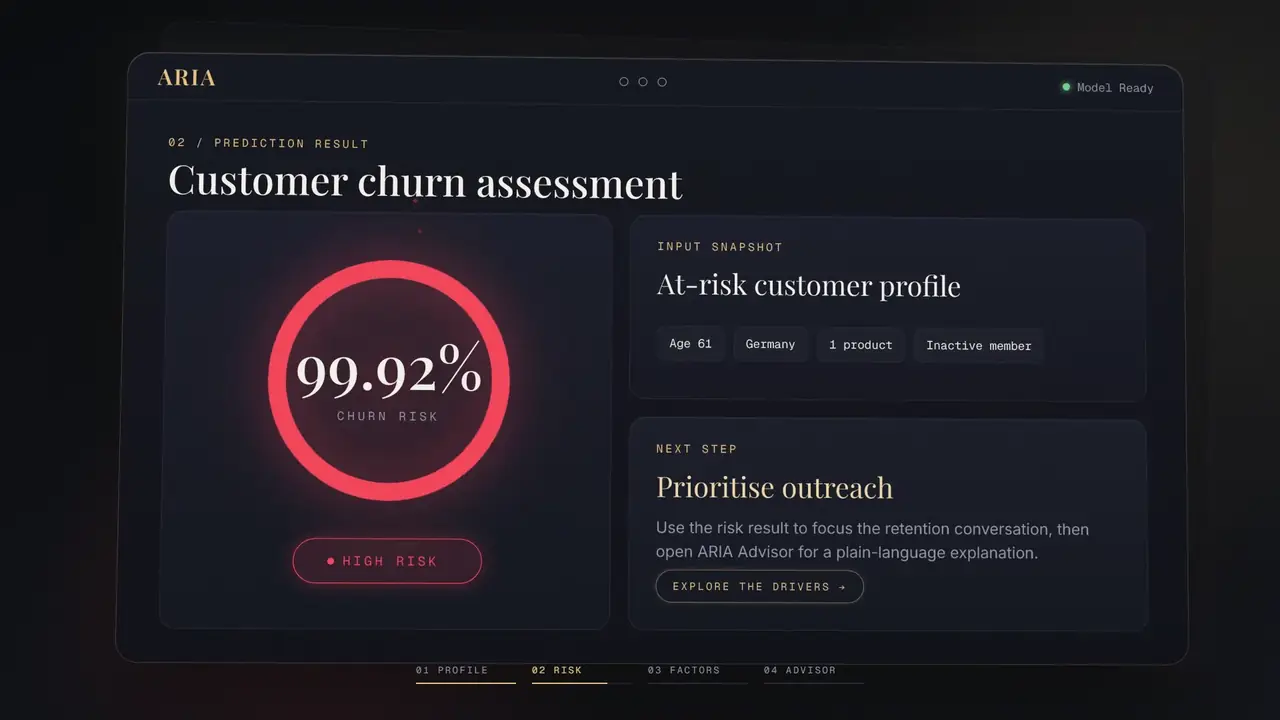
A churn score that bank staff can act on.
Predicts which customers will leave, then explains why in plain words and voice.
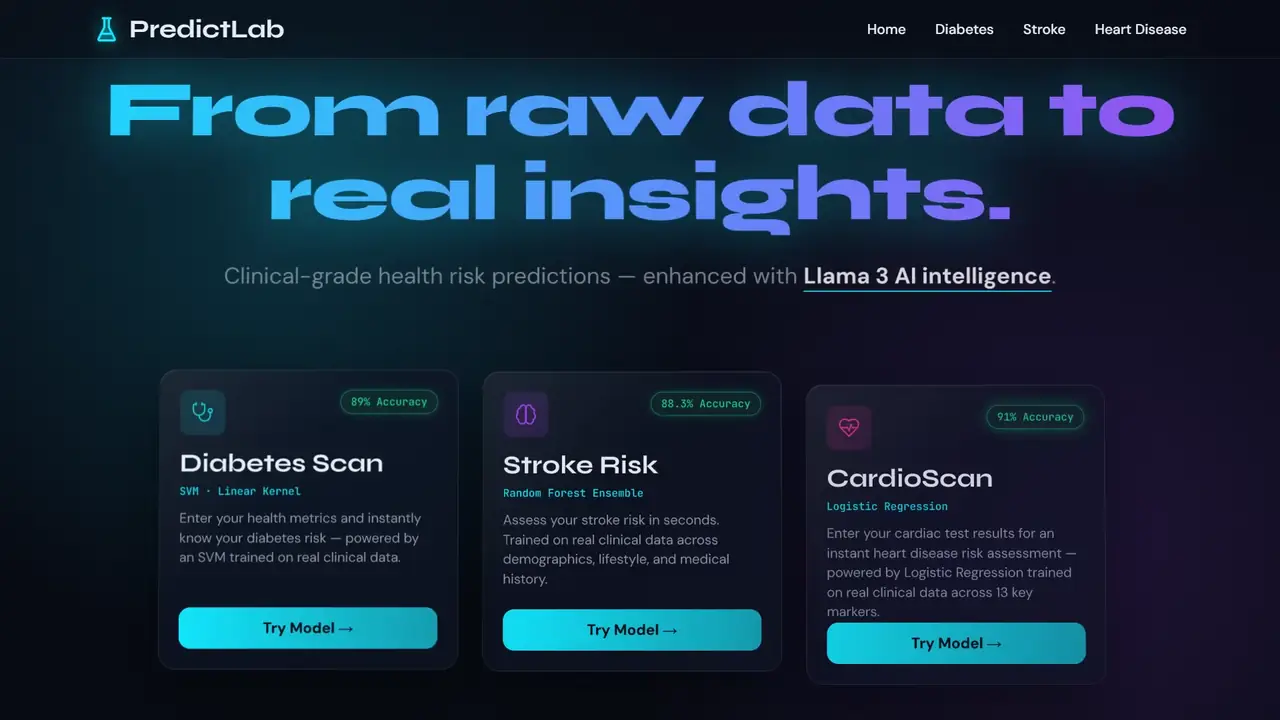
Screening results that explain themselves.
From raw health data to real insights.
01 / 04run_sandbox("loom-ai")
One AI workspace to chat, code in a live sandbox, study and delegate.

8.9 → 5.0 s
Median time to first token, with prompt caching
Median time to first token per turn, before and after transcript caching, on a ~80k-token loop (4 tool rounds). Per-turn range: 4.6–22.0 s before, 3.4–5.1 s after.
KPI 01 · Ask Neo
8
Models routed, with automatic provider fallback
Models in the routing table across Groq, OpenRouter and OpenCode, as listed in the README. A failed call retries on at most two alternates.
KPI 02 · Ask Neo
10
Specialist agents with human approval
Specialist agents on one parameterised graph, each pausing for human approval, as listed in the README.
KPI 03 · Ask Neo
Chat windows can't execute code or check answers against private documents. Coding, research and study each need their own tools and a real environment to run in.
LangGraph agent in an E2B sandbox; turns routed across 8 models, retried on up to 2 alternate providers
Chatbots talk about code. Loom runs it, inside a real Linux sandbox.1GitHub repository
Every turn is routed across 8 models. If a provider fails, the turn falls back to the next one.1GitHub repository
Caching the transcript cut median time-to-first-token from 8.9 s to 5.0 s.3Performance method
And the limits are written down, too.4Known limits
route_turn() · try it: take a provider down
Each provider toggles up/down. Primary first, then up to two alternates.
Provider names from the project; the replay is illustrative.
time_to_first_token() · median, ~80k-token test loop
Measured values from the performance method doc; playback is 10× faster than real time.
Routes across 8 models (Groq, OpenRouter, OpenCode) with 2-hop provider fallback
Persists graph state after every node visit; caches ~80k-token transcript
Concurrent read-only tool batches; sequential writes; lexical hashed RAG
User Prompt / Task · Repo Filesystem · PDF · Web · YouTube Sources
Typed WebSocket Trace · Live Dev Server Preview · Cited [n] Notebook Answers
MODULE 01
The Code agent gets a real Linux box (shell, filesystem, web search, dev servers) and streams every tool call over a typed FastAPI WebSocket contract into a live trace and preview. Read-only tool batches run concurrently; writes run in order.
MODULE 02
Learn turns PDFs, web pages and YouTube transcripts into answers with [n] citations and graded courses, and abstains when the sources don't cover the question. Retrieval uses lexical hashed vectors in pgvector.
MODULE 03
Each iteration is classified and routed across eight models. On a rate limit, quota or 5xx it retries on up to two alternate providers, and LangGraph checkpoints let sessions survive cold starts.
STACK & TOOLING MATRIX (8 TOOLS)
CITE-OR-ABSTAIN BOUNDARY
abstain ·I have no benchmark against other agents in my sources, so I won't claim that. The 8.9 → 5.0 s measurement I can cite.
DOCUMENTED LIMITS (6 OF 26)
source [2] · Technical Audit / Doc · Loom.ai
Architecture doc
github.com/vinayak533/loom.ai/blob/main/docs/architecture.md
source [3] · Technical Audit / Doc · Loom.ai
Performance method
github.com/vinayak533/loom.ai/blob/main/docs/performance.md
source [4] · Technical Audit / Doc · Loom.ai
Known limits
github.com/vinayak533/loom.ai/blob/main/docs/known-limits.md
source [5] · Technical Audit / Doc · Loom.ai
Models and routing
github.com/vinayak533/loom.ai/blob/main/docs/models.md
02 / 04rank_jobs("lazyhire")
Where AI finds the job that finds you.

9
Job sources merged and deduplicated
Job sources the ingest step aggregates, deduplicated on canonical URL plus company, title and location.
KPI 01 · Ask Neo
4
Application stages tracked
Stages in the app's application tracker (private repo).
KPI 02 · Ask Neo
PDF · DOCX
Private, guarded CV review
CV formats the private review accepts (private repo).
KPI 03 · Ask Neo
Listings around Technopark, Infopark and UL CyberPark are scattered across disconnected portals, full of duplicates, often missing dates, and linked to generic company homepages.
9-source ingest, deduplicated on URL plus company, title and location; MiniLM and SQLite FTS5 ranking; fabrication guard on CV edits
LazyHire pulls 9 job sources around Kerala's tech parks into one ranked list, minus the duplicates.1Case write-up and screens
Every match score opens up: freshness, source, location, role fit and skills.1Case write-up and screens
It tailors your CV, and rejects any edit it can't trace back to the original.1Case write-up and screens
The repo is private. Ask, and Vinayak will walk you through it.1Case write-up and screens
tailor_cv() · pick an AI-suggested edit
source CV (fictional)Built a FastAPI service that parses supplier invoices into PostgreSQL.
One of these edits invents something. The guard will catch it.
Toy guard: it checks numbers only. LazyHire's real checks cover numbers and requirements.
Validates apply links; deduplicates on canonical URL + (company, title, location)
Scores via local MiniLM embeddings + SQLite FTS5 across 5 transparent factors
Diffs tailored CV output against source CV; rejects unverified metrics or claims
9 Regional Job Portals · Candidate Source CV (PDF / DOCX)
5-Factor Match Breakdown · Verified Tailored CV · Encrypted Audit Log
MODULE 01
Aggregates 9 job sources, validates apply links, and deduplicates postings on canonical URL plus company, title and location.
MODULE 02
Ranks jobs with local MiniLM embeddings and SQLite FTS5 across freshness, source quality, location, role fit and skills, so every match score can be inspected.
MODULE 03
Rejects tailored CV output that fabricates numbers or requirements. Encrypted CV and account storage, per-request CSP nonces, CSRF checks on mutations, upload scanning and audit logging.
STACK & TOOLING MATRIX (8 TOOLS)
CITE-OR-ABSTAIN BOUNDARY
abstain ·None of my sources track hires, so I won't put a number on it.
source [1] · Case Write-up · LazyHire
Case write-up and screens
github.com/vinayak533/vinayak533#selected-work
03 / 04score_churn("aria")
Predicts which customers will leave, then explains why in plain words and voice.

10k
Customer records trained on
Rows in the bank-customer training dataset, per the README.
KPI 01 · Ask Neo
3
Actionable risk tiers
Churn-probability bands from the README: Low ≤35%, Medium 35–65%, High >65%.
KPI 02 · Ask Neo
5
Top predictive features surfaced
Global feature importances from the trained model, shown in the UI. They rank the model's drivers overall, not per customer.
KPI 03 · Ask Neo
A raw churn probability isn't actionable on its own. Bank staff need a risk assessment they can understand at a glance and talk through with the customer.
XGBoost classifier behind FastAPI; three risk tiers; Llama 3.3 writes the summary, ElevenLabs reads it
ARIA predicts which bank customers might leave: XGBoost on 10,000 records, balanced with SMOTE.1GitHub repository
It sorts them into Low, Medium and High risk and surfaces the top five drivers.1GitHub repository
Then Llama 3.3 explains why in plain words, and ElevenLabs reads it aloud.1GitHub repository
score_churn() · illustrative toy, not the trained model
Low risk
p(churn) ≈ 12%
Low risk. Activity is recent, so the usual check-ins are enough.
Balances minority churn class during training; shares deterministic scaler at inference
Computes calibrated p(churn), assigns Low/Med/High tier, extracts top-5 drivers
Llama 3.3 70B generates retention strategy; ElevenLabs synthesizes audio brief
10,000 Customer Records · Account & Activity Feature Vectors
Calibrated p(churn) Score · 3-Tier Risk Band + Top-5 Drivers · Spoken Retention Advisory
MODULE 01
XGBoost trained on 10,000 customer records, with SMOTE for class imbalance and one scaler shared by training and inference.
MODULE 02
FastAPI serves real-time churn probabilities, grouped into Low, Medium and High risk, alongside global feature-importance rankings.
MODULE 03
Llama 3.3 70B writes plain-language explanations and next-step retention strategies; ElevenLabs speaks them.
STACK & TOOLING MATRIX (6 TOOLS)
CITE-OR-ABSTAIN BOUNDARY
abstain ·My sources call it a prototype, so I won't claim a deployment.
source [1] · Repository · ARIA
GitHub repository
github.com/vinayak533/bank-churn-intelligence-platform
04 / 04screen_risk("predictlab")
From raw health data to real insights.

3
Clinical screening models
An SVM (diabetes), a Random Forest (stroke) and a Logistic Regression (heart disease), each a scikit-learn pipeline behind one FastAPI service.
KPI 01 · Ask Neo
30
Health inputs analysed
Input fields across the three screening forms: 8 + 10 + 12.
KPI 02 · Ask Neo
Preprint
Published on Zenodo, May 2026
Zenodo record v1.0, 17 May 2026. A preprint, not peer-reviewed.
KPI 03 · Ask Neo
A bare 'Diabetic / Not diabetic' output raises more questions than it answers for anyone without a medical or machine-learning background.
SVM, Random Forest and Logistic Regression behind one FastAPI service; Llama 3.1 explains each result
PredictLab screens for diabetes, stroke and heart-disease risk from 30 health inputs.1Live demo on Hugging Face
Three models, an SVM, a Random Forest and a Logistic Regression, behind one FastAPI service.2GitHub repository
Llama 3.1 explains every result in plain language. Vinayak published it as a preprint.3Research preprint (Zenodo DOI)
Toggle patient biomarker signals across 30 clinical indicators to see how PredictLab's 3-model ensemble (SVM · Diabetes, Random Forest · Stroke, Logistic Regression · Heart Disease) computes calibrated risk and abstains when inputs are out-of-range:
Dedicated scikit-learn pipelines: SVM (diabetes), Random Forest (stroke), Logistic Reg. (heart)
Single containerized backend serving UI, model inference, and assistant endpoints
Passes patient inputs + classifier verdict to Llama 3.1 8B for plain-language explanation
30 Clinical Biomarker Inputs · Diabetes (8) · Stroke (10) · Heart (12)
Multi-Condition Risk Screen · Plain-Language Clinical Context · Follow-Up Q&A
MODULE 01
An SVM for diabetes, a Random Forest for stroke and Logistic Regression for heart disease, each in its own scikit-learn pipeline.
MODULE 02
A single FastAPI backend serves the web interface, the prediction endpoints and the AI assistant with no frontend build step, containerized with Docker.
MODULE 03
Patient inputs and model outputs go to Llama 3.1 8B on Groq, which explains the result in plain language and answers follow-up questions.
STACK & TOOLING MATRIX (5 TOOLS)
CITE-OR-ABSTAIN BOUNDARY
abstain ·No source says it diagnoses anything, so I won't say it does. It's a screening tool that explains risk. For a diagnosis, see a doctor.
source [1] · Interactive Demo · PredictLab
Live demo on Hugging Face
huggingface.co/spaces/VINAYAKKV/Predict-Ai
source [3] · Research Preprint · PredictLab
Research preprint (Zenodo DOI)
doi.org/10.5281/zenodo.20253956
02 // SKILLS & TECHNOLOGIES
The foundation every AI role screens for
Strong programming and SQL fundamentals, with fast data analysis and clear dashboards that turn raw data into decisions.
Classical ML, NLP, vision and speech
End-to-end supervised pipelines with feature engineering, SMOTE for class imbalance, cross-validation, and tuning, extended to deep learning, computer vision, and speech.
Agents, RAG and grounded answers
Multi-agent systems with human-in-the-loop checkpoints. Every answer is grounded in indexed sources with citations, or the pipeline abstains instead of guessing.
Fast, reliable, evaluated APIs
Low-latency FastAPI services backed by SQL and NoSQL stores. Requests are routed across providers, prompt caching cuts time to first token, and output quality is measured with LLM-based evaluation.
From notebook to production
Models are containerized, tracked, and deployed through automated CI/CD pipelines on AWS, so every release is reproducible and monitored.
03 // PROFESSIONAL EXPERIENCE
Own the end-to-end AI/LLM engineering track on a four-person core product team, architecting multi-agent onboarding pipelines and real-time merchant analytics.
Architected and deployed a multi-agent LLM audit pipeline orchestrating store verification stages: Reduced manual store-audit turnaround by 80% during early merchant onboarding.
Engineered a high-throughput real-time merchant analytics backend with async query execution: Minimized API response latency across live merchant dashboard integrations.
Containerized AI inference microservices and automated production release workflows: Zero-downtime automated CI/CD deployments to cloud compute instances on every push.
Designed predictive retail demand-forecasting and customer-churn classifiers, packaging trained pipelines into low-latency REST inference endpoints.
Built supervised retail demand-forecasting and customer-churn classification pipelines: Delivered calibrated risk and demand predictions from structured transactional histories.
Serialized and served ML pipelines behind production REST inference endpoints: Cut inference latency for real-time streaming and downstream application consumers.
Standardized model artifact versioning, hyperparameter logging, and stakeholder reporting: Reproducible experiment lineage in MLflow paired with interactive Streamlit diagnostics.
Engineered credit-approval classification pipelines and class-imbalance mitigation workflows over large-scale, heavily skewed financial datasets.
Trained and tuned credit-approval classifiers across 280,000+ skewed financial records: Achieved 95% classification accuracy while preventing majority-class collapse.
Designed feature engineering, outlier scrubbing, and class-imbalance handling pipelines: Stabilized decision boundaries on heavily imbalanced applicant credit distributions.
Validated model generalization beyond raw accuracy on skewed class distributions: Benchmarked across F1-score, Precision, Recall, and ROC-AUC operating curves.
04 // CERTIFICATIONS & ACHIEVEMENTS
Participant, HackerRank Orchestrate Hackathon
Built and submitted a terminal-based autonomous support-triage agent.
Top 2%, LeetCode Weekly Contest 487
Rank 108 of 6,770.
Zenodo, DOI 10.5281/zenodo.20253956.
Bachelor of Computer Applications (BCA)
Mahatma Gandhi University, Kerala
Advanced Data Science & AI Specialization
Avodha Centre for IT Education
7-month intensive program, accredited by NSDC and Skill India.
Tap me to talk

NEO // run for vinayak k v
—
Each line links back to its step.
Tearing copies a plain-text summary, with Vinayak's email, to your clipboard.